Carpool schedule template
A shared driving rota that shows who has the run and how the driving is split.
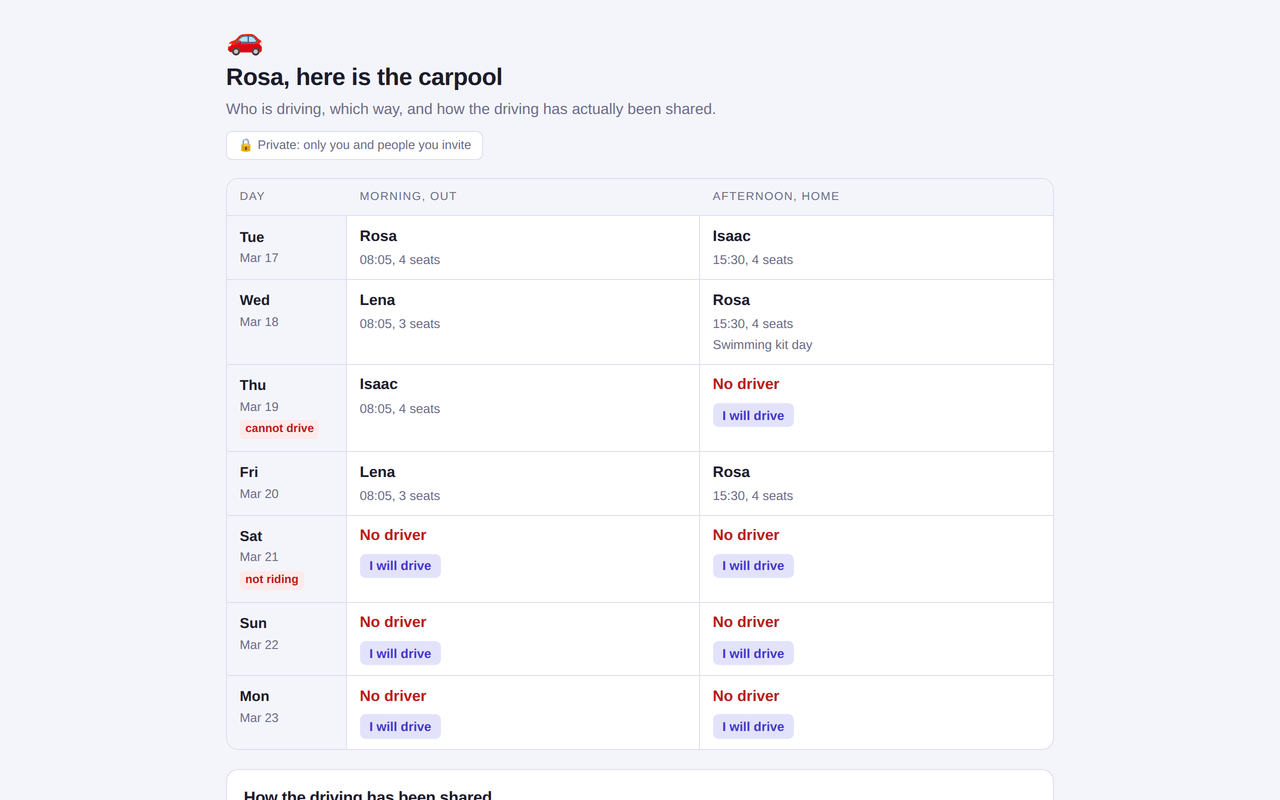
Live preview running the real template. The entries in it are sample data, not a real household's.
What's inside
Data it stores (2 collections)
drivesmembers can read, add and editnoticesmembers can read; you, members can add, you, creators can edit
No special permissions: this app runs entirely inside Homespun, with no outside network access.
A week of runs, and who has the wheel
Carpool Schedule shows the next seven days as a grid: one column for the run out in the morning, one for the run home in the afternoon, one row per day. A filled cell names the driver, the pick up time and how many seats that car has. An empty one says so plainly and offers a button that puts your name in it.
Under the grid sits the number that quietly decides whether a carpool survives, which is how many runs each person has actually done. It is counted from the runs themselves rather than from anybody's recollection, and it is deliberately a plain line of text instead of a chart, because it is meant to settle a question rather than start one.
Three families, one recurring argument
A carpool is two or three or four households who have agreed to share a drive that all of them would otherwise do alone. It works beautifully and it collapses for one of two reasons: nobody is sure who has tomorrow, or one parent has slowly ended up doing most of it and has not said so. Both are record keeping problems wearing a social costume.
Filling the empty cells
The grid starts empty and there is no starter content, because a made up school run is worse than none. The quickest way in is to describe the week out loud and let your AI write it, which is also how the load gets split evenly rather than falling to whoever answered first. Typing a run in by hand takes a date, a leg and a time.
Anybody in the pool can take an empty cell or correct a detail on a filled one, which is right for a group this size: the person who knows a pick up moved to quarter past is rarely the person who set the week up. Removing a run outright is kept to the owner, so nothing vanishes from the plan the night before without the organiser knowing.
Saying you cannot drive somewhere it will be seen
Under the grid is a short list of notices, which is where a cannot drive on Thursday goes so that it stops living in a chat thread that half the pool has muted. A notice is one of three things, being unable to drive, not riding that day, or running late, plus a date and a line of detail.
Each notice carries the account that posted it, and you can clear your own once it stops mattering. It is the difference between a message somebody may have read and a fact sitting next to the day it concerns.
Where the AI does the awkward part
The awkward part of a carpool is not the driving, it is the reallocating. Ask for the next fortnight and your AI writes it against the tally so the split comes out even, which is a much easier conversation than one parent raising it. Tell it somebody is away next week and it clears their runs and says which mornings are now uncovered.
The daily question is smaller and more common: who has tomorrow, and at what time. It reads the grid and answers in a sentence, which is faster than opening anything.
Things it does not know about
It has no idea where anybody lives. There are no addresses, no route, no map and no live location, so it will not tell a waiting parent that the car is five minutes away. It does not know the school calendar either, so an inset day is a run somebody has to clear.
The grid looks forward seven days and no further, so it is a weekly working surface rather than a term planner, though the runs already entered keep counting towards the tally. Nothing here notifies anybody: a notice posted at midnight is seen when somebody next opens the page.
Because every run and every notice carries the account that wrote it, the tally is evidence rather than an assertion, which is the thing a link anybody can open cannot give you. who is on the other end of a shared published link sets out how little such a page knows about the people opening it.
Questions people ask
- Can anyone in the pool change the schedule?
- Anyone invited can take an empty run or correct the details of one, because the person who knows something changed is often not the organiser. Deleting a run from the plan altogether is reserved for the owner.
- How does it work out whose turn it is?
- The page does not decide turns; it counts. It shows how many runs each person has on the board, and your AI uses that count when it writes the next fortnight so the driving comes out roughly even.
- Will it tell me when the car is on its way?
- No. There is no location tracking, no route and no alert of any kind. It records the plan and who agreed to it, and everything about where the car actually is stays a phone call.
- What happens when somebody cannot drive?
- They post a notice against that date, which sits under the grid with their name on it. The run can then be picked up by anyone else in the pool, or your AI can reshuffle the week and say what is left uncovered.